Squarespace vs Rocketspark NZ: Which is best for wellness or creative businesses?
A calm, practical guide for choosing the right website foundation in Aotearoa New Zealand
Introduction
Choosing a website platform can feel like standing at a fork in the path. Too many browser tabs open, too much conflicting advice, and the quiet worry of making the wrong call.
For many wellness practitioners, creative entrepreneurs, retreat operators, and boutique accommodation owners in Aotearoa New Zealand, the choice often narrows to two platforms: Squarespace or Rocketspark.
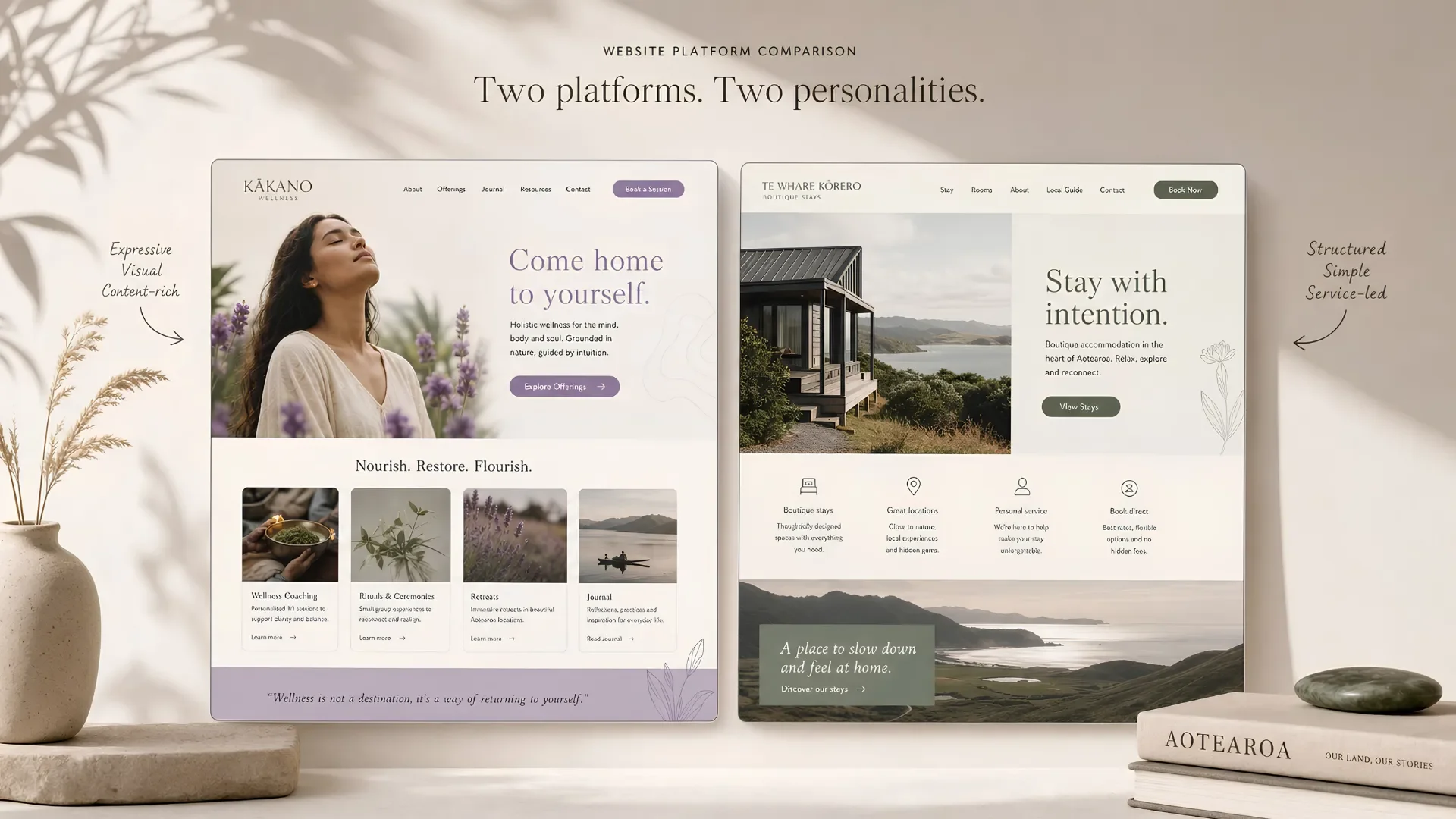
Both are capable. Both are popular. Squarespace is known for design flexibility, visual storytelling, and content-rich websites. Rocketspark is known for simplicity, reliability, and New Zealand-based support.
This guide isn't here to crown a universal winner. Instead, it's designed to help you choose the platform that fits your rhythm, your capacity, and the way your business actually runs. We'll compare Squarespace and Rocketspark through a grounded lens by considering design flexibility, editing experience, real-world features, local context, and long-term growth.
By the end, you’ll understand which platform is likely to suit your business, your capacity, and your way of working. And why.
Squarespace vs Rocketspark: a quick side-by-side comparison
| Feature | Squarespace | Rocketspark |
|---|---|---|
| Design flexibility | High | Moderate |
| Learning curve | Medium (3–5 hours to basics) | Low (1–2 hours to confidence) |
| Time per monthly update | 30–90 minutes | 15–30 minutes |
| Booking tools | Built-in (Acuity) | Third-party |
| Blogging depth | Strong | Simple |
| Digital products | Advanced options | Basic |
| Local NZ support | No | Yes |
| Billing currency | Check current regional pricing | NZD |
| Typical setup investment | 6–10 hours (DIY) or 2–3 weeks depending on complexity (with designer) | 3–6 hours (DIY) or 1–2 weeks depending on complexity (with designer) |
| Best for | Visual, content-rich brands | Stable, service-led businesses |
An overview of each platform
Squarespace
Squarespace is a globally recognised, design-led website platform known for its refined templates and all-in-one ecosystem.
It includes:
❃ Pages, blogs, and portfolios
❃ Built-in styling controls
❃ Scheduling (via Acuity)
❃ E-commerce and digital products
❃ A large ecosystem of extensions and integrations
Squarespace works particularly well for businesses where the website is part of the experience, not just a source of information.
This includes wellness practices with strong visual identities, creative studios, and experience-led brands such as retreat centres or boutique accommodation. These businesses often rely on imagery, white space, and storytelling to convey atmosphere, values, and care before a booking is ever made.
Rocketspark
Rocketspark is a New Zealand-founded platform designed with simplicity, reliability, and local support in mind.
It offers:
❃ A structured, row-based layout system
❃ Built-in hosting with NZ-based support
❃ Straightforward tools for service businesses and online stores
❃ Local billing in NZD
Rocketspark tends to appeal to business owners who want a website that feels stable, clear, and easy to maintain, without needing to make hundreds of design decisions. This often includes service providers, trades, and retreat centres with simple seasonal updates, without needing layered storytelling or frequent content updates.
What they have in common
Both platforms:
❃ Are fully hosted (no server management required)
❃ Produce mobile-responsive websites
❃ Can be used DIY or with a professional designer
❃ Suit small to medium-sized businesses
The difference isn't about quality, it's about fit.
Features that matter for wellness and creative businesses
Rather than listing everything each platform can do, let's focus on what actually supports day-to-day work.
Appointments and bookings
Booking systems are often central for wellness practices, retreats, and boutique accommodation, but the type of booking matters.
Squarespace’s native Acuity integration works well for practices offering 1:1 consultations, classes, workshops, discovery calls, or scheduled retreat sessions. More complex retreat bookings may still require careful setup or an additional booking workflow. Setup typically takes 2-3 hours for basic scheduling, longer for complex availability patterns. The benefit: once configured, clients book directly without email back-and-forth.
Rocketspark relies on third-party booking tools, which can be embedded and styled to feel cohesive with the site, and can be a good fit for accommodation businesses or service providers who want a clear enquiry or availability flow without layered booking logic. Setup time varies by tool but generally takes 3-5 hours including integration and testing.
If bookings are central to your business, Squarespace often feels more seamless, though Rocketspark can still work well with thoughtful setup.
Blogging and journalling
Content plays very different roles depending on the business.
For wellness practitioners, creatives, and retreat brands sharing long-form content - such as educational articles, seasonal reflections, itineraries, or stories - Squarespace’s blogging tools offer far more flexibility with categories, featured images, and layout flexibility. This is ideal for reflective posts, long-form writing, or design-led journals.
Rocketspark supports simpler blog formats, which suit businesses that publish occasionally and do not need visually complex articles.
If content is a key growth channel, Squarespace has the edge. Many practitioners find that writing reflective posts becomes part of their client connection strategy. If that resonates with you, prioritise blogging depth.
E-commerce and digital products
Both platforms support online stores.
Squarespace offers more flexibility for digital products, memberships, and layered content journeys. Best for: digital downloads, course access, membership content, flexible product variations.
Rocketspark focuses on clear product catalogues and straightforward checkout flows. Best for: physical product stores, straightforward retail, wholesale accounts.
Pricing considerations
Pricing can change, so it is always worth checking each platform’s current plans before making a decision. But cost should not be measured by the monthly subscription alone.
When comparing Squarespace and Rocketspark, consider:
❃ Monthly platform cost
❃ Booking tool costs
❃ Email marketing or newsletter costs
❃ E-commerce transaction fees
❃ Template or design costs
❃ Designer setup costs
❃ Time required to maintain the site
❃ Future migration costs if the platform no longer fits
Squarespace may involve extra costs if you add scheduling, email campaigns, memberships, or third-party integrations. Rocketspark’s local billing and support may feel simpler for New Zealand businesses, especially those who prefer NZD invoicing and local assistance.
The best-value platform is not always the cheapest one. It is the one that fits your workflow and reduces friction over time.
Editing experience and learning curve
Squarespace
Learning timeline: Plan for 3-5 hours of focused exploration to feel comfortable with the basics, and 2-3 weeks of regular use to feel confident. Squarespace offers a 14-day free trial, which is useful for testing the editor before committing. If you work with a Squarespace designer, you will also benefit from a discount on an annual subscription.
Squarespace uses inline editing, meaning you can see changes as you make them. Blocks handle text, images, galleries, forms, and layouts.
Many business owners appreciate:
❃ The visual nature of editing
❃ The depth of styling control
❃ The ability to refine details over time
There is a bit of a learning curve, however, particularly around:
❃ Mobile spacing
❃ Section stacking
❃ Advanced settings
Squarespace suits those willing to invest time learning the system, or those working alongside a designer. If you enjoy the process of refinement, Squarespace can feel creatively satisfying. If website work feels like a burden rather than a craft, the flexibility might create friction.
Rocketspark
Learning timeline: Most business owners feel comfortable within 1-2 hours, fully confident within a week.
Rocketspark's editor is more straightforward, with clearer boundaries and fewer settings.
This often feels supportive for:
❃ Time-poor founders
❃ Business owners with limited tech energy
❃ Anyone who wants to "set and maintain" rather than continually refine
In service-based practices like counselling, business owners often prioritise low-maintenance systems that let them update availability or publish a short post quickly, without needing to revisit design or settings each time. Rocketspark supports that kind of quiet, sustainable rhythm.
The editing experience matters more than many people expect, especially for businesses managing bookings, seasonal changes, or availability.
For wellness practitioners publishing content regularly, or retreat operators updating offerings and schedules, Squarespace’s flexibility can feel empowering over time. For businesses making infrequent updates, such as seasonal availability or occasional project photos, Rocketspark’s simplicity can feel far more sustainable.
Which platform suits which type of business?
| Business type | Better fit | Why |
|---|---|---|
| Wellness practitioner with regular blog content | Squarespace | Stronger blogging, visual storytelling, and booking integration |
| Retreat operator with layered offerings | Squarespace | More flexibility for retreat pages, resources, imagery, and content journeys |
| Retreat centre with simple seasonal updates | Rocketspark | Stable, clear, and easy to maintain |
| Creative studio or artist | Squarespace | Better for portfolios and expressive layouts |
| Local service business | Rocketspark | Simple structure, local support, and low-maintenance editing |
| Digital product or resource-based business | Squarespace | Better suited to downloads, memberships, and layered content |
How the right platform changes by business type
Scenario: Squarespace for a content-rich wellness practice
Imagine a content-led wellness practice, such as a naturopath, nutritionist, somatic practitioner, integrative therapist, or holistic health practitioner whose website needs to hold more than basic service information.
In this kind of setup, the website is not simply there to say who you are and how to book. It often becomes a living library for your work - a place where prospective clients can understand your approach, feel into your values, and build trust before they ever make an enquiry. The site may need space for:
❃ long-form educational blog posts (for example, on gut health, nervous system support, sleep etc.)
❃ recipe resources and downloadable guides, checklists, or client handouts
❃ online booking for consultations, classes, workshops, or discovery calls
❃ clear service pathways for different client needs
❃ practitioner philosophy, credentials, testimonials, and trust-building content
❃ newsletter sign-ups and gentle nurture journeys
❃ future offers such as digital products, memberships, online programmes, or resource libraries
When a practitioner is publishing regularly, the website becomes an extension of the practice itself. It is not just a booking tool. It is part of the client relationship.
A visitor might arrive through a blog post, read more about your approach, download a guide, join your newsletter, and later book a consultation when the timing feels right. For wellness businesses where trust, education, and emotional resonance matter, that kind of layered journey is important. In these scenarios, Squarespace is often a strong fit.
Why Squarespace tends to work well in this context:
❃ Built-in Acuity integration supports seamless consultation bookings
❃ Flexible blog layouts allow for rich formatting, imagery, and clear reading flow
❃ Resource libraries with downloadable PDFs are easy to structure
❃ Visual design controls make it easier to create a calm, grounded, and brand-aligned experience
❃ Pages can be shaped around different services, audiences, or stages of the client journey
❃ The design can evolve as the practice grows, without feeling overly boxed in by the original structure
The trade-off:
Squarespace asks for more time and attention upfront. There is a learning curve around layouts, mobile spacing, section styling, and maintaining visual consistency.
With initial guidance, this might look like several focused hours getting comfortable with the platform, followed by around an hour or so each month maintaining content, publishing articles, updating resources, or refining pathways.
For content-driven practitioners, that time often feels generative rather than purely administrative. The website becomes a place to deepen the work, not just maintain the machinery. Very wellness, very useful, and far less “update the website while sighing into your tea.”

Scenario: Rocketspark for a retreat centre with simple seasonal updates
Now consider a service-based business, such as a retreat centre, which needs a professional, trustworthy online presence without ongoing content demands.
In this scenario, the website’s role is to:
❃ clearly introduce the retreat centre, its setting, and its values
❃ present upcoming retreats, workshops, or seasonal offerings
❃ show the space through simple image galleries
❃ explain what guests can expect before they enquire
❃ provide a clear enquiry or booking pathway
❃ make occasional seasonal updates easy to manage
Updates may happen a few times a year, perhaps when new retreat dates are released, photos are refreshed, or details are adjusted for the coming season. The business may not need regular blogging, layered resources, or a highly customised content journey.
Why Rocketspark often works well here:
❃ Setup is straightforward, with fewer design decisions required
❃ NZ-based support is available during local business hours
❃ Billing in NZD simplifies accounting
❃ The structured layout system keeps project uploads consistent
❃ Simple updates can be made without needing to revisit the overall design each time
The trade-off:
Rocketspark offers less design flexibility than platforms like Squarespace. The result is a site that feels clear, grounded, and easy to maintain, rather than highly expressive or content-rich.
For some retreat centres, that simplicity is exactly what is needed. If the website’s main purpose is to communicate trust, show the space, list upcoming retreats, and guide visitors towards an enquiry, Rocketspark can provide a stable and low-maintenance foundation.
However, if the retreat centre plans to grow into deeper storytelling, regular journal content, digital resources, practitioner profiles, multi-day retreat sales pages, or a more immersive brand experience, Squarespace may offer more creative room over time.
Common platform-choice mistakes
(and how to avoid them)
Choosing Squarespace for its beauty, then resenting the time required to manage it
Before committing, honestly assess: Do I realistically have time for regular content updates or layout refinement? Do I enjoy that process? If no to either, consider Rocketspark's simplicity.
Choosing Rocketspark for simplicity, then feeling boxed in as the business grows
If you're planning to add courses, memberships, or more layered content journeys within 2 years, Squarespace's flexibility will likely serve you better long-term. For example, feeling boxed in can show up for growing retreat businesses who later want to add layered retreat pages, content journeys, or digital resources - features that benefit from greater design flexibility.
Letting price decide, rather than workflow and capacity
A $10-20/month price difference becomes irrelevant if the platform creates friction in your weekly rhythm. Choose for fit, not just cost.
Selecting a platform before clarifying services, content, and growth plans
Map your content strategy first: What will you update weekly? Monthly? Annually? What might you add in year two? Does my business operate year-round, or seasonally - and how often will the site realistically need updating? The platform should serve your plan, not limit it.
A platform won't fix unclear strategy, but the wrong one can amplify frustration.

How to choose the right platform for you
Instead of asking "Which platform is better?", try these questions:
Where are most of my clients based?
If primarily NZ/Australia, Rocketspark's local support and NZD billing may feel more grounding.
How much time and energy do I realistically have for website updates?
If website work feels like a burden: Rocketspark. If it feels like an extension of your creative practice: Squarespace.
Do I want my website to feel expressive, or quietly functional?
Both are valid approaches. Wellness spaces often lean expressive; service businesses often lean functional.
Will I be adding bookings, content, or digital products in the next 2–3 years?
Map your 2-year plan before choosing. Platform migrations are possible but costly in time and energy.
Do I prefer local support, or am I comfortable navigating global platforms?
Rocketspark's NZ-based team responds in your timezone. Squarespace offers extensive documentation and global community support.
Squarespace may be the better fit if:
❃ Your brand is visually led
❃ You value design flexibility and content depth
❃ You're open to a learning curve or working with a designer
❃ Bookings are central to your business model
❃ You plan to publish regular blog content or resources
Rocketspark may be the better fit if:
❃ You're NZ-based and value local support
❃ You want a stable, low-maintenance site
❃ Simplicity and clarity matter more than experimentation
❃ You update your website infrequently (quarterly or less)
❃ Your business is service- or product-focused rather than content-led
Frequently Asked Questions
-
Yes, but it is rarely a simple one-click process. Moving from Squarespace to Rocketspark, or from Rocketspark to Squarespace (or to any other platform), usually means rebuilding the site structure, redesigning key pages, moving images and copy, reconnecting forms or booking tools, and carefully redirecting important URLs. Expect 15-25 hours of work (DIY) or $2,000-5,000 (professional migration) depending on site complexity.
If your business is likely to grow into courses, memberships, resources, or more layered content, it is worth choosing a platform that can support that direction early.
-
Neither platform automatically wins for SEO. SEO success depends more on structure, content quality, and clarity than the platform alone. Both Squarespace and Rocketspark provide the basics, including page titles, descriptions, image alt text, mobile-responsive layouts, and blog functionality.
For New Zealand businesses, SEO success usually depends more on:
Clear service pages
Local keyword targeting
Fast-loading images
Helpful content
Google Business Profile optimisation
Internal linking
Location-specific trust signals
Squarespace may suit content-rich SEO strategies better because of its stronger blogging and layout flexibility. Rocketspark can still work well for local service businesses with a clear structure and thoughtful setup. For local NZ businesses, both platforms handle location-based SEO effectively when set up correctly.
-
Squarespace is a better fit if you are comfortable experimenting, refining, and learning as you go. If you want the simplest possible editing experience, Rocketspark may feel calmer.
Not inherently, but it rewards intention. Many beginners do well with 2-3 hours of guided setup (via tutorials or professional support) followed by gradual learning. The platform grows with you. If the learning process feels overwhelming rather than interesting, that's valuable information pointing toward Rocketspark's simplicity.
-
No , both platforms are designed for DIY use. However, many businesses find a designer can help with the parts that the platform does not solve for you, such as brand direction, page structure, copy flow, user experience, SEO foundations, and visual consistency. This can save hours of trial-and-error, and creates a stronger foundation. Think of professional design as optional but often efficient, particularly if website work doesn't energise you.
A DIY site can work beautifully when your needs are simple. A designer becomes more valuable when the website needs to communicate trust, hold layered offerings, or support business growth.
-
For many wellness practitioners, Squarespace is often the stronger fit because it supports visual storytelling, reflective content, online booking, resources, and calm, brand-led layouts.
Rocketspark may be better for practitioners who want a simple, low-maintenance website with clear service information, contact details, and occasional updates.
The right choice depends on whether your website is mostly a digital brochure, a booking tool, or a deeper part of your client relationship.
Booking-heavy practices (yoga teachers, counsellors, naturopaths) often lean toward Squarespace for Acuity integration. Content-rich practices (health coaches, nutritionists who blog regularly) also benefit from Squarespace's depth. Service-focused practices with simpler needs (massage therapists, beauticians with straightforward booking through external tools) often find Rocketspark perfectly sufficient. The deciding factor: how central is your website to your client journey?
-
Start by mapping what your website needs to do over the next two years. Consider whether you will need bookings, retreats, resources, blog content, digital products, or a simple service-based presence.
If both platforms still seem viable, the best next step is a short platform decision session. A clear outside perspective can save hours of second-guessing and help you choose a foundation that fits the way you actually work.
Key takeaways
❃ Both Squarespace and Rocketspark are solid platforms
❃ The "best" choice depends on how you work, not just what you sell
❃ Design flexibility and simplicity are a trade-off, not a hierarchy
❃ Time investment differs significantly: Squarespace requires more learning but offers more flexibility; Rocketspark requires less ongoing attention but provides less creative control
❃ Choosing with clarity now saves friction later
❃ Your platform should support your rhythm, not create resistance
Gentle next steps
If you're still unsure, you don't need to decide alone.
Platform decision session: A focused 60-minute session to map your website needs, assess your capacity, and recommend the platform that best fits your business.
Best for: business owners choosing between Squarespace, Rocketspark, or another website foundation.
Design partnership: A calm, collaborative website build on Squarespace or Rocketspark, shaped around your brand, content, and way of working.
Best for: businesses ready for a more intentional website foundation.

Stay connected: Receive thoughtful monthly insights on website design, branding, platforms, and sustainable digital growth.